The Australia & New Zealand Buyer's Guide to Sourcing Food from India
An essential market-entry and procurement guide for Australian and New Zealand importers sourcing packaged food products from India.
Table of Contents (26 sections)↓
- At a Glance
- 1. Starting with the Destination Market
- 2. Navigating the Trans-Tasman Regulatory Ecosystem
- FSANZ Chapter 1 & Chapter 2 Requirements
- Australia (DAFF & ABF) vs New Zealand (MPI) Enforcement
- 3. The Complete Procurement Journey
- 4. Documentation Intelligence & Verification
- 5. End-to-End Logistics & Shelf Placement
- 6. Building Long-Term Sourcing Trust
- Frequently Asked Questions
- Can food products imported from India sell in both Australia and New Zealand under one compliance check?
- What biosecurity risks are most scrutinised by DAFF when importing food from India?
- How does the AI-ECTA trade agreement lower tariffs for Australian food importers sourcing from India?
- What lab test reports are mandatory before shipping food products from India to Australia?
- What happens if a shipment fails DAFF biosecurity inspection at an Australian port?
- Are Indian organic certifications automatically recognized in Australia and New Zealand?
- How can Australian buyers ensure that Indian suppliers use food-safe packaging materials?
- What is the difference between mandatory biosecurity clearance and FSANZ food safety inspection?
- How do storage and transport temperature conditions affect product compliance upon arrival?
- What supplier audit protocols should Australian category managers enforce before onboarding?
- How does ECTA Certificate of Origin validation work during customs clearance?
- How does Taraka streamline Trans-Tasman compliance for food importers?
- Sources & References
- Trans-Tasman Regulatory Authorities
- Trade & Bilateral Agreements
- Industry & Food Safety Bodies
Practical Market-Entry Evaluation for Importers, Retail Category Managers, and Distributors

Figure 1.0: Start with the destination market before evaluating the factory
At a Glance
| Objective | Requirement |
|---|---|
| Market Eligibility Screening | Verify if the product can legally enter Australia or New Zealand |
| Trans-Tasman Regulatory Compliance | Ensure alignment with FSANZ, DAFF, or MPI requirements |
| Documentation Audit | Validate Health, Phytosanitary, and Lab Analysis certificates |
| Biosecurity Protocols | Confirm processing and ingredient standards meet strict biosecurity rules |
| Retail Readiness | Assess packaging, labelling, and shelf-life for Trans-Tasman retail channels |
Starting with the Destination Market
Most sourcing problems do not begin at the port. They begin much earlier, often during the excitement of discovering a promising supplier. A buyer receives an attractive quotation, samples look excellent, production capacity appears sufficient, and discussions quickly move towards pricing and shipping. Weeks later, the product requires a redesigned label, an unexpected declaration, additional technical documentation, or fails to satisfy an import condition that was never checked at the beginning of the project.
None of those problems are manufacturing failures. They are decision failures. The difference between an efficient procurement process and an expensive lesson is usually determined long before the first purchase order is issued. That is why experienced procurement teams reverse the traditional sequence. They do not start by evaluating factories. They first evaluate the market. Only after understanding how the destination market works do they begin comparing suppliers.
Before requesting quotations, experienced buyers answer fundamental questions regarding market eligibility. This approach reduces unnecessary negotiation and shortens supplier evaluation later in the procurement process.
Figure 1.1: Market evaluation precedes supplier negotiation
Navigating the Trans-Tasman Regulatory Ecosystem
Australia's and New Zealand's import systems are best understood as an ecosystem rather than a collection of agencies. Success depends on understanding which question each organisation answers.
FSANZ Chapter 1 & Chapter 2 Requirements
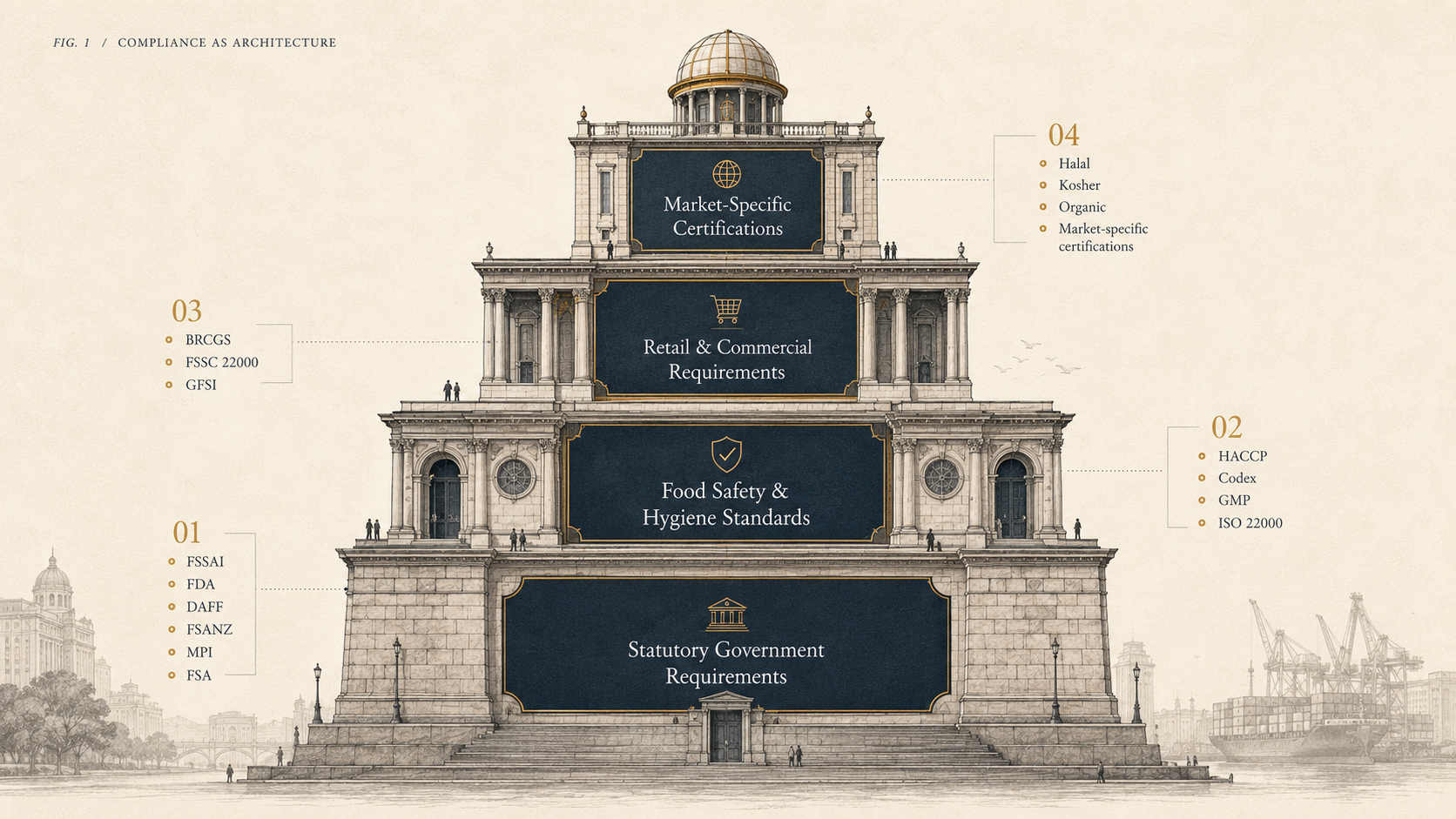
The Food Standards Australia New Zealand (FSANZ) Code applies across both countries, dictating labelling, composition, and contaminant limits. Buyers must ensure suppliers understand Chapter 1 (General Food Standards) and Chapter 2 (Food Product Standards) requirements, as compliance here is non-negotiable for retail readiness.
Australia (DAFF & ABF) vs New Zealand (MPI) Enforcement
Although Australia and New Zealand share many food standards, they administer imports independently. In Australia, the Department of Agriculture, Fisheries and Forestry (DAFF) manages biosecurity through BICON, while the Australian Border Force (ABF) administers customs. In New Zealand, the Ministry for Primary Industries (MPI) controls import health standards, and New Zealand Customs handles clearance. Buyers should avoid assuming that compliance in Australia automatically guarantees compliance in New Zealand.

Figure 2.0: The Trans-Tasman regulatory ecosystem covering FSANZ, DAFF, and MPI
The Complete Procurement Journey
A product may be legally importable, but that alone does not make a manufacturer a suitable long-term partner. Experienced buyers reduce procurement risk by evaluating suppliers through evidence rather than marketing claims.
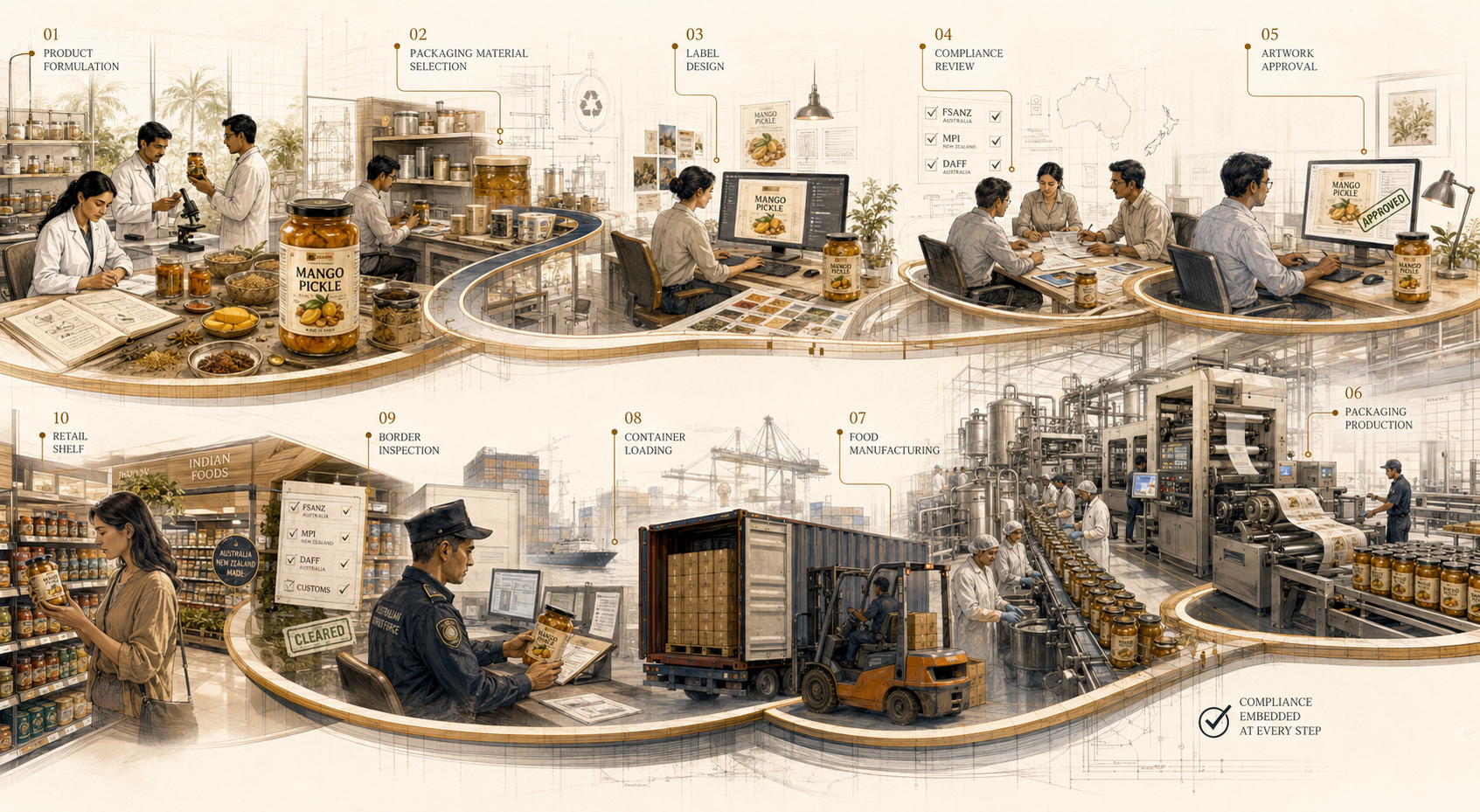
The procurement journey begins with supplier discovery and moves through structured technical and commercial reviews before validating product samples. The strongest buyers eliminate unsuitable suppliers early, ensuring that negotiations only occur with export-ready, technically capable manufacturers.

Figure 3.0: The end-to-end buyer procurement journey from screening to shelf placement
Documentation Intelligence & Verification
Every document answers a procurement question. Verifying documentation early prevents costly delays during customs clearance.
Critical import documents include the Certificate of Origin, which is essential for tariff preferences under the Australia-India Economic Cooperation and Trade Agreement (AI-ECTA). Additionally, buyers must routinely audit FSSAI licences, APEDA registrations, Health Certificates, Phytosanitary Certificates, and independent Laboratory Analysis Reports to ensure the supplier's quality systems align with destination market requirements.

Figure 4.0: Documentation and intelligence verification protocols for import clearance
End-to-End Logistics & Shelf Placement
Legal compliance allows a product to enter a country, but retail readiness determines whether it earns shelf space. Moving products from an Indian factory to an Australian or New Zealand supermarket involves rigorous supply chain control.
Temperature-controlled transit is vital for sensitive goods, while thorough preparation is required for DAFF or MPI port inspections. In addition, retail packaging must be scrutinised for compliant ingredient lists, allergen declarations, and nutrition panels. Packaging failures are among the most common reasons for costly rework upon arrival.

Figure 5.0: The supply chain journey from Indian factory to Trans-Tasman retail shelf
Building Long-Term Sourcing Trust
The final question is no longer whether a supplier can export, but whether they can become a dependable long-term business partner.
Many first shipments succeed, but far fewer supplier relationships deliver consistent quality over several years. Buyers look for trust signals such as organised documentation, transparent communication, and stable production planning. Supplier relationship management requires establishing a consistent audit cadence and validating operational consistency before scaling order volumes. The most valuable supplier is rarely the cheapest supplier.

Figure 6.0: Building long-term procurement trust and scaling supplier relationships