Essential Export Documentation and Compliance for Indian Imports
Getting products out of India and into your market requires precise documentation. Missing or incorrect paperwork is one of the most common causes of shipment delays, port holds, and financial penalties in international trade.
This guide provides a complete reference for importers and distributors sourcing from India. It covers every document you may need, common compliance pitfalls, and how Taraka International manages the process to eliminate documentation-related risks.
Why Documentation Matters
International trade compliance is not optional. Customs authorities at both the export and import ends verify documentation before releasing cargo. Errors in a single document, whether it is the HS code on an invoice or a missing certificate of origin, can result in:
- Shipment holds at port
- Additional inspection fees
- Penalty charges or fines
- Goods being returned to origin
- Loss of the buyer's preferential duty rate
Taraka International handles regulatory compliance and export documentation as part of every sourcing engagement, so importers avoid these risks.
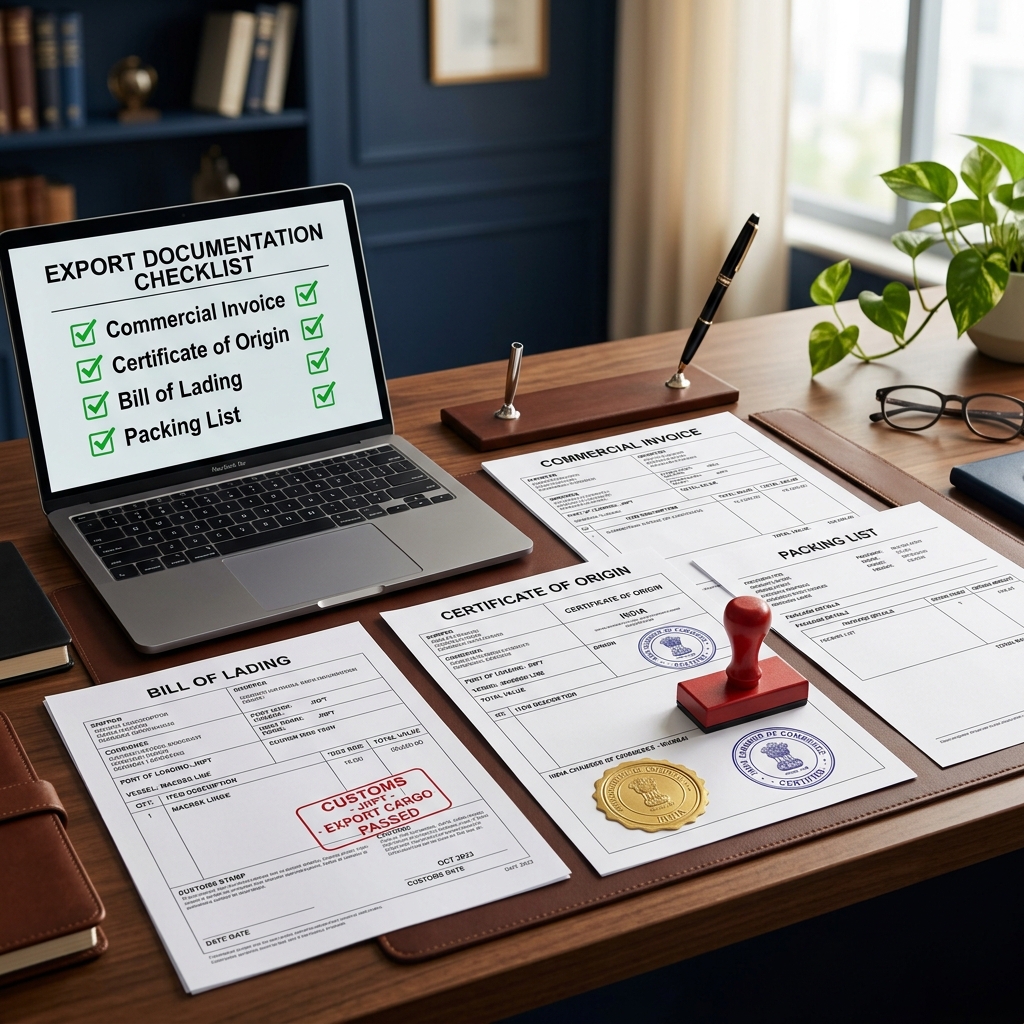
Essential Documents Checklist
Commercial Documents
| Document | Purpose |
|---|---|
| Commercial Invoice | Itemised statement of goods sold, including quantities, unit prices, total value, and payment terms |
| Proforma Invoice | Pre-shipment invoice used for order confirmation, letter of credit applications, and import permit requests |
| Packing List | Detailed list of contents per package, including weights, dimensions, and package markings |
| Weight Certificate | Official weight verification, often required for bulk commodities |
Shipping Documents
| Document | Purpose |
|---|---|
| Bill of Lading (B/L) | Contract of carriage between shipper and shipping line for sea freight. Acts as proof of shipment and title to goods |
| Airway Bill (AWB) | Equivalent of B/L for air freight shipments |
| Shipping Bill | Filed with Indian customs for export clearance. Mandatory for all outbound shipments from India |
| Mate's Receipt | Issued by the ship's captain confirming goods received on board |
Regulatory and Compliance Documents
| Document | Purpose |
|---|---|
| Certificate of Origin (CoO) | Attests the country of manufacture. Required for preferential duty rates under FTAs |
| IEC (Importer-Exporter Code) | Mandatory registration for all Indian exporters. Issued by DGFT |
| FSSAI Certificate | Required for food and agricultural product exports from India |
| Phytosanitary Certificate | Issued by plant quarantine authorities for agricultural and horticultural products |
| Fumigation Certificate | Confirms wooden packaging or cargo has been treated against pests |
| GMP/ISO Certificates | Quality management certifications for pharmaceutical, wellness, and industrial products |
| CE Marking Documentation | Required for products entering the European market |
| Halal/Kosher Certificates | Required for food products entering markets with religious dietary requirements |
| BIS Certification | Bureau of Indian Standards certification for regulated product categories |
Financial Documents
| Document | Purpose |
|---|---|
| Letter of Credit (L/C) | Bank instrument guaranteeing payment upon presentation of compliant documents |
| Insurance Certificate | Proof of marine or cargo insurance covering the shipment |
| Bank Realisation Certificate (BRC) | Confirms receipt of export payment in India. Required for claiming export incentives |
Common Documentation Pitfalls
Incorrect HS Codes
The Harmonized System (HS) code determines the duty rate applied to your import. Using an incorrect code can trigger additional duties, penalties, or customs holds. Each product must be classified accurately based on its composition, function, and end use.
Missing or Expired Certificates
Product-specific certificates (FSSAI, phytosanitary, CE) must be current and match the exact product being shipped. Expired certificates or certificates that do not match the shipment contents will be rejected at the destination port.
Inconsistent Documents
Customs authorities cross-reference all documents in a shipment set. Discrepancies between the commercial invoice, packing list, bill of lading, and certificate of origin, even minor ones like different product descriptions, can cause clearance delays.
Counterfeit or Non-Recognised Certificates
For markets with strict import controls (EU, GCC, Australia), ensure all certificates are issued by recognised bodies. Taraka verifies the authenticity of every certification before including it in the shipment documentation.
How Taraka International Handles Documentation
Taraka sits between you and your suppliers to coordinate the entire documentation process. Here is what that looks like in practice:
- Document planning: Before production begins, Taraka identifies every document required for your specific product and destination market.
- Supplier coordination: Taraka works with the manufacturer to obtain product-specific certificates (GMP, FSSAI, test reports) during production.
- Document preparation: Commercial invoices, packing lists, and shipping bills are prepared with consistent descriptions, quantities, and values across all documents.
- Compliance review: Every document set is reviewed for accuracy, completeness, and cross-referencing before submission to customs.
- Submission and clearance: Taraka manages the customs filing process at the Indian port and provides all documents required for clearance at the destination.
Incoterms: What Importers Should Know
The Incoterm agreed upon determines who is responsible for documentation, shipping, and risk at each stage of the shipment. Common terms used in India trade:
| Incoterm | Exporter Responsibility | Importer Responsibility |
|---|---|---|
| FOB | Deliver goods to the Indian port, cleared for export | Arrange and pay for ocean freight, insurance, and destination clearance |
| CIF | Deliver goods to the destination port, including freight and insurance | Handle destination customs clearance and inland delivery |
| DDP | Handle everything through to the buyer's warehouse, including destination duties | Minimal, receive goods at warehouse |
Taraka supports all standard Incoterms and advises importers on the best option based on their logistics setup and risk preferences.
Frequently Asked Questions
Do I need an IEC code to import Indian goods? No. The IEC is required on the Indian exporter's side. As the importer, you need your country's equivalent import licence or registration. Taraka International is an IEC-registered exporter.
What Incoterms should I choose? FOB is the most common for experienced importers who have their own freight arrangements. CIF is preferred by buyers who want the exporter to manage shipping. Discuss your preference with Taraka, and the team will advise based on your specific situation.
How long does customs clearance take? At Indian ports, export clearance typically takes 2 to 4 working days with complete documentation. Destination clearance timelines vary by country and product category.
Can Taraka handle documentation for regulated products? Yes. Taraka manages documentation for food products (FSSAI), agricultural goods (phytosanitary), wellness supplements (GMP), textiles (OEKO-TEX), and other regulated categories.
What happens if a document is rejected at the destination port? Taraka's pre-submission review process is designed to prevent rejections. In rare cases where a destination authority requests additional documentation, Taraka coordinates with the supplier and certification bodies to resolve the issue promptly.
Image credit: Generated by Taraka AI